Not every piece of cargo fits neatly inside a standard shipping container. When freight is too wide, too tall, or shaped in a way that makes traditional container loading impractical, shippers often turn to a different type of equipment altogether: the flat rack container.
ATS International Services, Inc., the international shipping arm of Anderson Trucking Service (ATS), helps shippers find the best transportation solutions for their cargo every day — and that includes determining the best equipment type to properly contain and protect shipments.
In this guide, we’ll break down what flat rack containers are, how they work, the types and dimensions available, and the situations where they make the most sense for international shipping. We’ll also look at the limitations of flat racks so shippers can determine when this specialized equipment is the right fit for their cargo.
Flat Rack Containers: Definition & Types
A flat rack container is a piece of specialized shipping equipment used when cargo cannot fit inside a standard 20-foot or 40-foot shipping container. A flat rack has no side walls and no roof, featuring only a solid, reinforced base and sturdy end walls.
There are two flat rack container types — collapsible and fixed. These terms refer to the functionality of the end walls of the container:
- Collapsible flat rack containers have end walls that can be folded down to facilitate easier loading. This also allows multiple empty flat racks to stack together, which is convenient for the logistics provider that owns the equipment.
- Fixed flat rack containers have end walls that do not collapse, which makes for a hardier, stronger piece of equipment. Fixed flat racks are often used for especially heavy or otherwise extreme loads for this reason. Fixed flat racks can also be stacked, but they cannot be folded down, so they require more space when empty than their collapsible counterparts.
The open design of a flat rack container is useful for transporting out-of-gauge (OOG) cargo and otherwise irregular loads, as it allows for greater loading flexibility. Flat racks can be loaded from the top or sides of the container depending on the loading equipment on hand and the specs of the load itself.
Heightened loading flexibility can help prevent costly damage during freight transfers, as there are fewer limiting factors (like container walls and ceilings) to impede smooth, safe loading and unloading.
Learn more about flat rack containers, including helpful visuals, in the video below:
Flat Rack Dimensions
Like standard containers, the most common dimensions for flat racks are 20- or 40-feet long. However, flat racks differ from standard containers in that they do not have side walls or a roof, so their "internal" and "external height" dimensions are somewhat less defined.
In general, the internal measurements of a flat rack container are approximately:
- 20-foot flat rack container: 19.5'L x 7.7'W x 7.7'H.
- 40-foot flat rack container: 39.8'L x 7.9'W x 7'H.
External heights are usually 8'6" or 9'6", the latter of which is referred to as "high cube" flat rack. High cube flat racks are used when additional vertical clearance is needed for loading and unloading.
How Does a Flat Rack Container Work?
Cargo is loaded onto a flat rack from the top or sides using a crane or forklift. Once loaded, the cargo is secured via lashing strips, which are tied down to various securement points on the sides and floor of the flat rack. Lashing helps prevent cargo shifting during transit.
The cargo and flat rack container are then loaded onto a vessel using lift-on/lift-off (Lo/Lo), a cargo shipping method using onboard or dockside cranes to load and unload goods.
Like standard containers, flat rack containers are stackable, and may be loaded stacked to maximize space usage.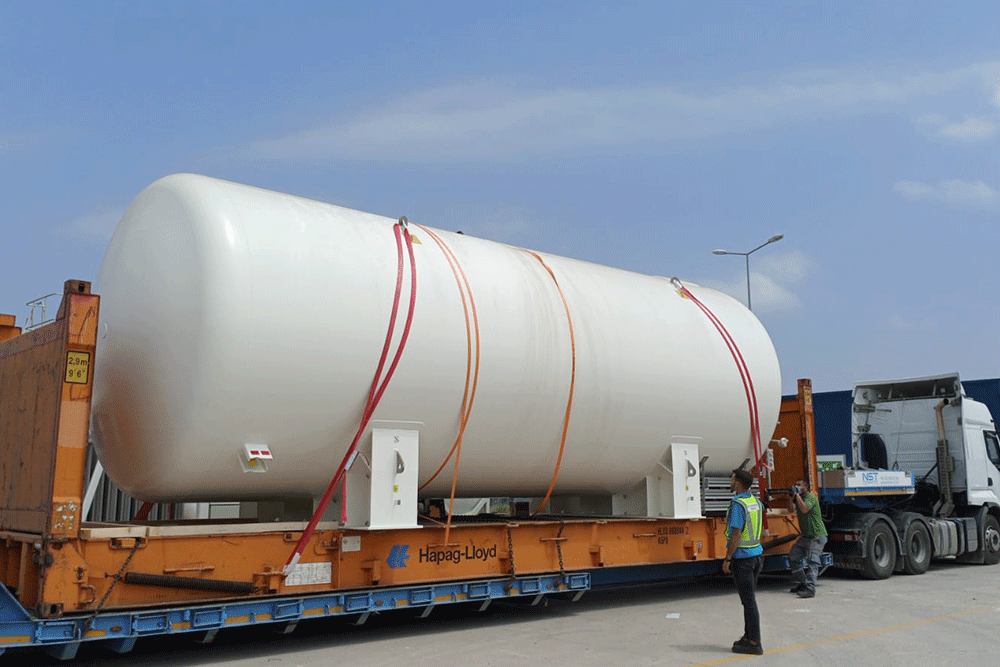
Flat Rack Cargo Types and Usage Scenarios
Flat rack containers are primarily used in international shipping and move on container vessels. Using a flat rack instead of shipping breakbulk or roll-on/roll-off (Ro/Ro) can offer shippers more sailing options, which can create efficiencies of both time and money.
As mentioned above, flat rack containers are commonly used to ship OOG cargo that can't fit into a standard shipping container. They can also be used to ship cargo that could fit into a standard container, but would be easier to load onto a flat rack.
Types of cargo best suited for flat rack containers include:
- Boats and vehicles
- Construction materials
- Heavy machinery and equipment, such as excavators, bulldozers, cranes, pavers, mining trucks, and agricultural tractors
- Industrial components, such as pipes, tubes, steel coils, beams, generators, and transformers
- Military/defense equipment, such as armored vehicles, large shelters, and field machinery
Flat Rack Container Disadvantages
Like any piece of transportation equipment, flat racks aren't the right fit for every cargo type, circumstance, or supply chain. Here are some factors to consider before choosing a flat rack:
- Cost & Efficiency: Standard containers are far more common than flat racks, which makes them significantly cheaper and easier for ports to handle. Most ports already have container cranes, while flat racks may require specialized cranes and operators, adding extra cost.
- Transportation & Loading: Standard containers can be hauled by truck directly to a shipping facility for loading and unloading. They can also be transported by rail. Flat racks are typically kept at ports and rarely travel far inland, making them less convenient for shippers.
- Cargo Protection: Shipping in a container allows cargo to stay in the same sealed unit from origin to destination, reducing handling and the risk of damage or theft. Flat racks expose cargo to weather and rely on tarps, which don’t provide the same level of protection.

Is Flat Rack Container Shipping Right for You?
For shippers moving oversized machinery, vehicles, industrial components, or other OOG freight, flat racks provide the flexibility needed to load and transport cargo safely. Understanding how flat racks work, their dimensions, and when they make sense can help ensure your freight moves internationally using the equipment best suited for the job.
With that said, flat racks are a specialized solution rather than the default choice. Standard containers remain more common, easier to handle at ports, and better suited for protecting cargo from weather and theft.
Ultimately, if your cargo is oversized or requires loading flexibility, you may have no choice but to ship with a flat rack container — that's precisely what they were made for. But if your cargo could fit in a traditional container, there's little to be gained from shipping it via flat rack instead, especially where cost and efficiency are concerned